Vintage Halloween
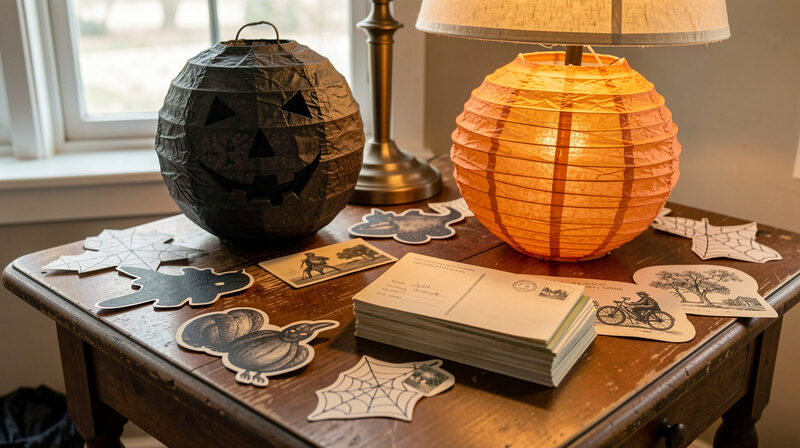
Before Halloween was a night, it was a picture. Between about 1900 and the 1930s the holiday was carried on paper: postcards posted by the million, crepe paper lanterns, die cut cats and owls pinned to the wall, invitations, seals and napkins for the party at home. That printed Halloween is what this section is about, and it is a richer subject than the modern shop shelf suggests.
What this section covers
Two pages make up the strand. Vintage Halloween postcards looks at the golden age of the Halloween card, the publishers who competed for it and the symbols they used again and again. Collecting vintage Halloween decorations turns to the objects themselves, how paper die cuts and lanterns were manufactured, how to judge the age of a piece and how collectors keep fragile paper alive.
Why the imagery looks the way it does
The Halloween of the old cards is not the Halloween of the horror film. It is warm, autumnal and domestic: pumpkins and turnips, black cats with ribbons, owls on a branch, witches flying over a farmhouse, children bobbing for apples, a mirror held up to catch a future husband. The palette runs to orange, black, gold and a soft green. Much of this comes from the party trade rather than from folklore. Manufacturers needed cheerful, repeatable pictures for a product sold to families, and they built a visual language that still reads as Halloween today.
The darker imagery existed too, but it was playful rather than gory. A skeleton might dance with a cat. A ghost might be drawn as a friendly sheet. The scare was a game, and the design kept it that way.
Paper, the material of the old Halloween
The reason so much of this survives as flat, colourful paper is that paper was cheap and printing was fast. Crepe paper could be folded into lanterns and hats. Die cut cardboard could be punched into cats, bats and skeletons and hung by a thread. Seals and gummed labels decorated envelopes and invitations. None of it was built to last, which is exactly why the pieces that did last are now studied and collected.
How to read an old piece
A collector learns to look at three things at once: the printing, the material and the mark. A lithographed card from the early 1900s has a softness that later offset printing does not. A die cut from the same period has a particular stiffness and a printed back. A maker's mark, a patent date or a country of origin can place a piece within a few years. The pages in this section explain these signals, and they are honest about the difficulty: Halloween goods were often sold unmarked, and many reproductions exist.
Where the section sits in the site
Vintage Halloween is the second of four strands. It follows Origins and folklore, which sets out where the night came from, and it feeds Decorating and carving, where the same symbols reappear on a modern porch. Celebrating and safety completes the set with the evening itself.
For a wider view of the print culture this section draws on, the collections held by the Getty's online collection show how commercial illustration of the same years is studied and catalogued.
Why old Halloween still matters
The vintage Halloween matters because it is the moment the holiday became a designed thing. Once manufacturers were printing cats and pumpkins for a mass market, the imagery stopped being local and started being shared. A child in Ohio and a child in Yorkshire saw the same orange cat with the same green ribbon. That shared picture is the ancestor of every plastic pumpkin on a modern doorstep, and understanding it makes the present version easier to read.
The Halloween that the paper recorded
Put a hundred pieces of this material side by side and a clear picture of the old holiday appears. It was kept indoors, by families, with games and food. It was not frightening in the modern sense, and it was not aimed at adults. The witch was a neighbour in a pointed hat, the ghost was a friend under a sheet and the skeleton was a joke. The mood was autumn: harvest, candlelight, bare trees and the first cold evenings. Anyone who has wondered why a modern Halloween decoration so often shows a smiling cat beside a pumpkin is looking at the direct descendant of this period.
The paper also records who was doing the buying. The catalogues and party guides of the time were addressed to the household, and they sold a complete evening in a box: invitations, decorations, table settings and games, all coordinated. Halloween was, in that sense, one of the first holidays to be sold as a designed experience rather than as a single object. That idea is still with us, and it began on paper.
Where to see the material for yourself
Large public collections of printed ephemera and commercial illustration hold examples of this work, and many of them are catalogued online. Looking at a genuine piece beside a photograph of a reproduction is the fastest way to train the eye. Libraries, local museums and specialist archives in both Britain and the United States hold Halloween cards, catalogues and party goods, and the cataloguing conventions they use are the same ones described in the collecting page. A reader who lives near such a collection can usually arrange to view material by appointment.
How to use these pages
A reader who has inherited a box of old cards can start with the postcard page and learn what the pictures show. A reader who wants to buy or sell a paper decoration should read the collecting page first, because the difference between a genuine 1920s die cut and a modern reprint is mostly a matter of detail. Both pages link to the rest of the site, so a reader can move from the picture to the pumpkin without losing the thread.
Vintage Halloween
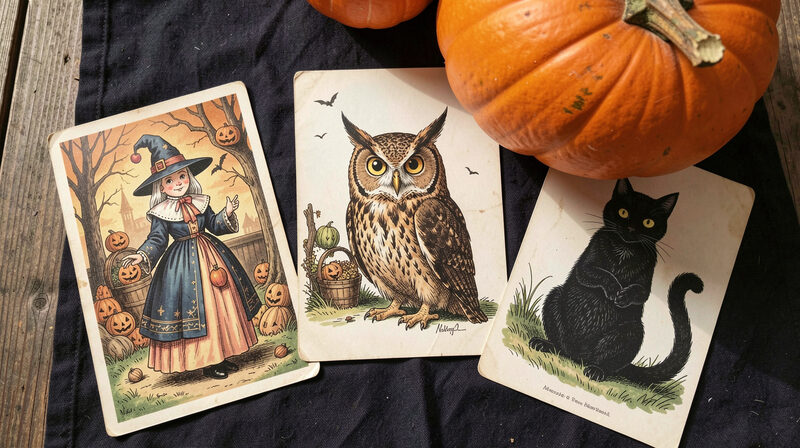
Vintage Halloween Postcards
The golden age of Halloween postcards, the publishers behind it and the symbols, from owls and cats to turnips, that fill the old cards.
Witches, owls and cats, printed by the million and kept in albums.
Vintage Halloween
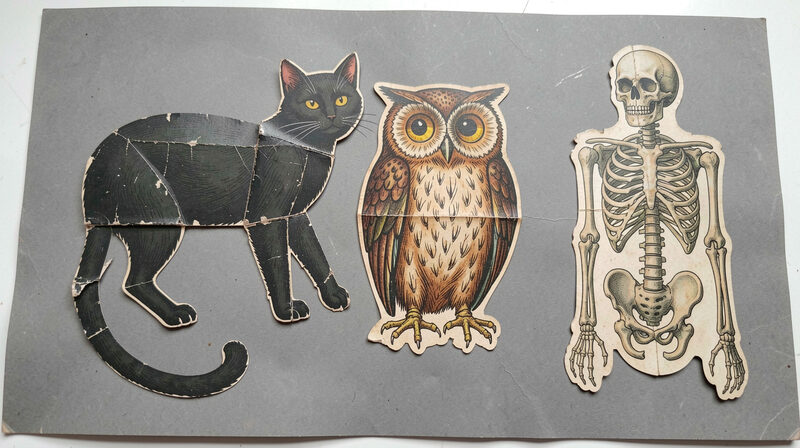
Collecting Vintage Halloween Decorations
How paper die cuts, lanterns and noisemakers were made, how to judge their age and how collectors store fragile Halloween pieces.
How die cuts were made, dated and stored without destroying them.