From Samhain to Halloween
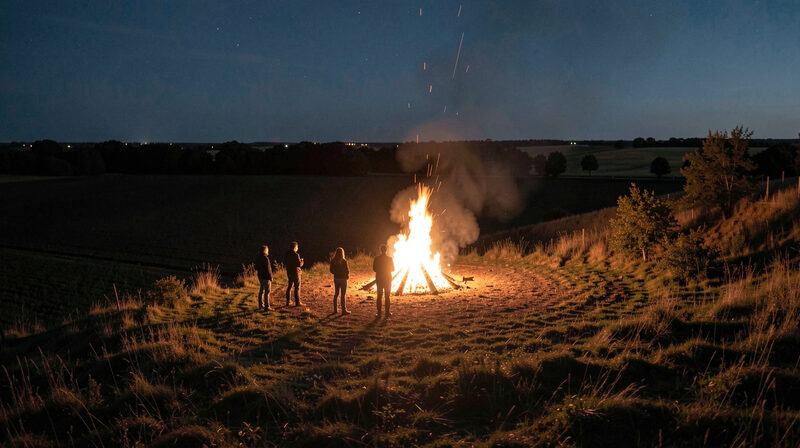
The night of October thirty first has two histories running side by side, and they are often told as one. The first belongs to the Gaelic festival of Samhain, a marker of winter's arrival kept in Ireland and parts of Scotland. The second belongs to the Christian calendar, where the first of November became the feast of All Saints and its evening became All Hallows' Eve. The two share a season and a mood. How far they share an origin is a question that historians still answer with care, and this page keeps that care rather than smoothing it out.
What Samhain was
Samhain is an Old Irish word meaning roughly the end of summer. It named the point in the year when the harvest was in and the dark half of the year began, and it was one of the quarter days around which the Gaelic year turned. In the medieval Irish texts that survive, Samhain appears as a time of assembly, feasting and story. It is also the moment when the ordinary world and the otherworld are said to come close, and several tales use that closeness to bring a supernatural encounter into the narrative. That detail, recorded in literature rather than in a rulebook, is the strongest surviving link between Samhain and the eerie reputation Halloween later carried.
What Samhain was not, on the evidence available, is a tidy pagan new year with a fixed ritual that can be described in a paragraph. The claim that it began the Celtic year is debated. The claim that it involved a night of human sacrifice rests on a small number of late and contested sources and is not treated here as established.
How the Christian feast was fixed
The Christian side of the story has dates that can be followed. In the seventh century a feast of all martyrs was kept in Rome in May. In the eighth century a chapel in Saint Peter's was dedicated to all saints, and the commemoration was moved towards the first of November. By the ninth century the first of November was widely observed across western Europe as the feast of All Saints, also called All Hallows. The evening before a feast is its vigil, so the evening of October thirty first became All Hallows' Eve, which is where the word Halloween comes from.
Did one replace the other?
The popular version says the Church placed its feast on top of a pagan festival in order to absorb it. The chronology does not fit that claim as neatly as it is usually told. The feast moved for reasons that belong to Rome and to the calendar of saints, and Samhain was a local Gaelic observance rather than a single empire wide rite. It is more accurate to say that the two observances occupied the same turn of the year and gradually blended in the regions where both were kept. Over centuries, the eve gathered customs from several sources, and the result is the night we would recognise today.
The customs that joined in
By the late medieval and early modern period the eve carried a mixture of practices. In Ireland and Scotland there were games and divination, including attempts to learn the name of a future partner by peeling an apple or looking into a mirror. In England there was souling, in which the poor went from door to door asking for soul cakes in return for prayers for the dead. Bonfires were lit in parts of Britain, a practice also tied to the commemoration of a failed plot on the fifth of November. All of these fed the same night in different places.
How it crossed the Atlantic
The nineteenth century carried these customs to North America with Irish and Scottish immigrants. In the United States the eve was first a rural and then a town celebration, and by the late nineteenth century it had become a community party with games, fortune telling and homemade food. The rowdier side of the night, with pranks and minor vandalism, drew a deliberate response from towns and newspapers, which encouraged a more organised and domestic form of celebration. That turn towards the party and the porch is the setting in which trick or treating later took shape.
The lantern and the picture
The visual Halloween arrived with print. The carved lantern, which began as a turnip in Ireland and Scotland, is treated on its own page at the jack o lantern. The orange cat, the owl and the witch on a broom came later still, through commercial illustration and the party trade, and are covered in the vintage Halloween section. The night we see is therefore older than its pictures and younger than its feast.
What remains uncertain
A reader who wants the honest version should hold three things together. Samhain is real and documented, but not in the form that popular retellings give it. The Christian feast moved onto the first of November for reasons of its own. And the modern night is a blend assembled over centuries, with a large share of its familiar detail invented in the last two hundred years. For the broader account used here, the History channel's page on Samhain gathers the main threads and shows where the sources thin out.
What to take from it
Halloween does not need a single clean origin to be worth understanding. It is more interesting as what it actually is: a Gaelic quarter day, a Christian vigil and an American street custom layered on top of one another. Once the layers are separated, every part of the modern night, from the lantern to the sweets, has a place in the story and a date attached to it.