Collecting Vintage Halloween Decorations
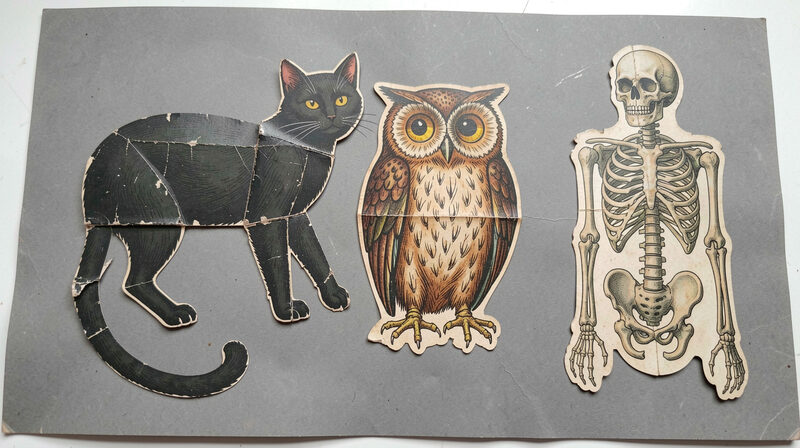
Long before Halloween was a night for shop bought costumes, it was a night for paper. From about 1900 to the 1930s, the party at home was furnished with printed card, crepe paper, die cut shapes and gummed seals, most of it made to be used once and thrown away. The pieces that survived are now collected, studied and, in some cases, worth a great deal. This page explains how that paper was made, how to judge the age of a piece and how to keep fragile Halloween objects alive.
The makers who built Halloween
One firm in particular shaped the look of the American Halloween party. The Dennison Manufacturing Company of Massachusetts sold crepe paper, seals, napkins, invitations and die cut decorations under a Halloween line, and its catalogues and party guides told hosts exactly how to use them. A second major name, the Beistle Company of Pennsylvania, founded at the start of the twentieth century, produced die cut decorations in large numbers. Other makers joined in, and the result was a whole material culture of Halloween built from paper.
How the objects were made
The main techniques were simple and repeatable. Die cutting pressed a shaped blade through card or paper to produce a flat figure, which was then printed in colour and often finished with a scored fold so that it would stand or hang. Crepe paper was printed, folded and gathered to make lanterns, hats, honeycomb balls and streamers. Seals and labels were printed on gummed paper and licked onto envelopes. Because the processes were cheap, a household could decorate a room for very little, which is exactly why the trade grew so fast.
The shapes and the symbols
The decoration followed the imagery of the postcard. Cats, owls, bats, skeletons, ghosts, pumpkins and witches appear again and again, usually in flat, cheerful colour. A die cut cat might have jointed limbs so that it could be posed. A honeycomb pumpkin might fold flat and open into a ball. A lantern might be printed with a face and lit from inside. The designs were meant to be playful, and even the skeletons are drawn with a smile. This shared visual language is the reason a modern Halloween decoration still looks the way it does, and it is the same language described in the postcard page.
How to judge the age of a piece
Dating a paper decoration is a matter of small signals. The printing matters: early pieces are lithographed and have a soft, slightly grainy surface, while later pieces are printed more flatly. The material matters: older card has a different stiffness and ages to a warmer tone. The construction matters: hand assembled joints, staples or stitched threads point to an earlier date than glued or moulded plastic parts. Marks matter most of all: a maker's name, a patent date, a series number or a country of origin can place a piece within a few years. None of these signals is decisive alone, and unmarked Halloween goods were common, so a collector reads several at once.
Reproductions and how to spot them
Because the originals are desirable, reproductions are everywhere. A modern reprint is usually flatter in colour, printed on brighter and more uniform paper, and cut with a cleaner edge. The back is often blank where an original might carry a mark, and the scale may be slightly off. A collector learns to compare a doubtful piece with a known original and to treat an unusually pristine example with suspicion. The public collections of commercial illustration held by institutions such as the Getty's online collection show how this kind of material is catalogued and compared.
Storing fragile paper
Paper from this period is acidic and brittle, and it does not like light, heat, damp or handling. The accepted practice is to store pieces flat, between sheets of acid free tissue, in a box that keeps out light and dust. Adhesive tape should never be used, because it stains and eventually fails. Crepe paper should be kept unfolded where possible, since repeated folding breaks the fibres. A piece that is already torn can be stabilised with a paper conservator, and a valuable item is worth the cost.
What is collected today
Collectors divide the field in several ways. Some focus on one maker, building a run of a single company's output across the years. Some focus on a form, such as die cut figures or honeycomb decorations. Others collect the printed paper of the party itself, the invitations, napkins and seals that were used once and thrown away. Condition drives value more than rarity in most cases, which is why a clean, complete piece is worth far more than a torn one.
Where to begin as a collector
A new collector does not need to start with the rarest pieces. A single unmarked die cut, a printed invitation or a party napkin from the period will teach most of what matters about printing, paper and construction, and it costs very little. From there, the eye improves with comparison. Handling ten ordinary pieces tells a collector more than reading about a famous one, and the ordinary pieces are the ones that can still be found in a box of household paper at a sale.
It also helps to decide what the collection is for. A collector who wants a display should buy pieces in good condition that can be shown. A collector who wants to study the trade should buy catalogues and printed guides as well as objects, because the guides explain what the objects were for. Both routes are legitimate, and both are cheaper at the start than at the end.
Why it is worth keeping
The old Halloween paper is worth keeping because it records a holiday at the moment it became a designed, domestic thing. It is the physical version of the imagery that later moved to plastic and to the doorstep, and the objects described in the decorating and carving section are their direct descendants. A box of these pieces is a small archive of how the night was kept, and it is treated as such by the collectors who hold it.