Vintage Halloween Postcards
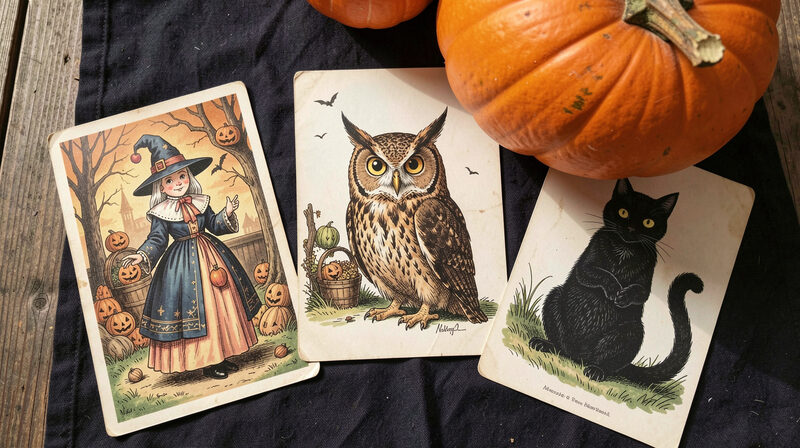
Between about 1900 and the early 1920s, Halloween lived on a postcard. The cards were cheap to buy, cheap to send and printed in enormous numbers, and they carried a version of the holiday that has almost nothing to do with the horror film and everything to do with autumn, home and courtship. Reading a stack of them is one of the fastest ways to understand what Halloween looked like before it was a night of costumes and sweets.
Why postcards took over
The postcard boom at the turn of the twentieth century was a product of cheap postage, fast printing and a public that loved to send short messages. A card cost a penny or two, the postal rate was low, and delivery was often same day in a city. Publishers competed hard for the seasonal trade, and Halloween was one of the biggest seasons of the year. Cards were produced for Christmas, Valentine's Day, Easter and Halloween in the tens of millions, and the Halloween cards were among the most inventive.
The publishers behind the cards
Several firms dominated the market. Raphael Tuck and Sons, a British publisher with a strong American branch, produced finely lithographed Halloween cards with embossed surfaces and gilded detail. John Winsch, an American publisher, is remembered for cards with heavy embossing and rich colour. Other names recur on the backs of surviving cards, including International Art Publishing, E. Nash and the Gibson Art Company. The cards were often printed in Germany, where colour lithography was most advanced, which is why a German printer's mark appears on many American Halloween cards of the period.
What the pictures show
The imagery is remarkably consistent. Pumpkins and turnips appear on almost every card, often carved and lit. Black cats with ribbons round their necks sit beside them. Owls perch on branches, sometimes wearing spectacles and reading a book. Witches fly over farmhouses and fences on brooms, usually smiling rather than threatening. Children bob for apples in a tub, hold mirrors to see a future partner, or peer into a fire for a sign. Ghosts, when they appear, are drawn as soft white sheets with gentle faces. Skeletons and devils exist, but they are usually comic.
The colour and the mood
The palette is warm and seasonal: orange, black, gold, a soft green and the cream of the card itself. The mood is nostalgic rather than frightening. Many cards show a farm or a cottage in autumn, with bare trees and a harvest moon, and the supernatural element is placed inside that landscape as part of the season rather than as a threat. The overall effect is closer to a harvest festival than to a haunted house, and it is this version of Halloween that the cards preserved.
Divination and the games
A large share of Halloween cards show the games and divinations of the night. Bobbing for apples is the most common. Others show a young woman looking into a mirror at midnight, or peeling an apple in one strip and throwing it over her shoulder to read the shape of a future partner's initial. These customs belong to the folklore of the eve, and the cards turned them into pictures that could be sent to a friend. The same practices appear in the written record of the period, which is treated at the origins and folklore section.
How the cards were sent and kept
Halloween cards were posted in the days before the thirty first, often with a short greeting and the sender's name. Many were kept in albums, and that is why so many survive in good condition. Some were never sent at all, kept by the shop or by the buyer as a small collectible. The practice of keeping postcards in albums is the reason the imagery of the period is still available to study today, and it is why collectors can trace a single publisher's output across several seasons.
What happened to them
The postcard boom faded after the First World War. Paper shortages, changing postal rates and the rise of the telephone reduced the habit of sending cards, and the great era of the Halloween postcard closed. The holiday itself did not disappear; it moved to the party and the doorstep, and the imagery was taken up by a new trade in paper decorations, which is the subject of the collecting page. Some of the same publishers continued for a time, but the golden age of the card was over by the early 1920s.
How to read a card today
A collector looks at the printing, the paper and the back. A genuine card from the period has a particular feel, a slightly soft lithographic surface and often an embossed edge. The back may carry a publisher's mark, a series number or a printed greeting. Reproductions exist and are common, and the difference is usually visible in the flatness of the print and the quality of the paper. Larger public collections of printed ephemera, such as those catalogued by the New York Public Library's digital collections, show how this kind of material is documented and dated.
Why the cards still matter
The cards matter because they show a Halloween that was designed to be gentle. They are the clearest record of the moment the holiday became a commercial picture, and they explain the orange cat, the owl and the smiling witch that still appear on modern decorations. A reader who wants to understand why Halloween looks the way it does could do worse than spend an hour with a set of these cards, and the objects they inspired are treated next in collecting vintage Halloween decorations.