The Jack o Lantern
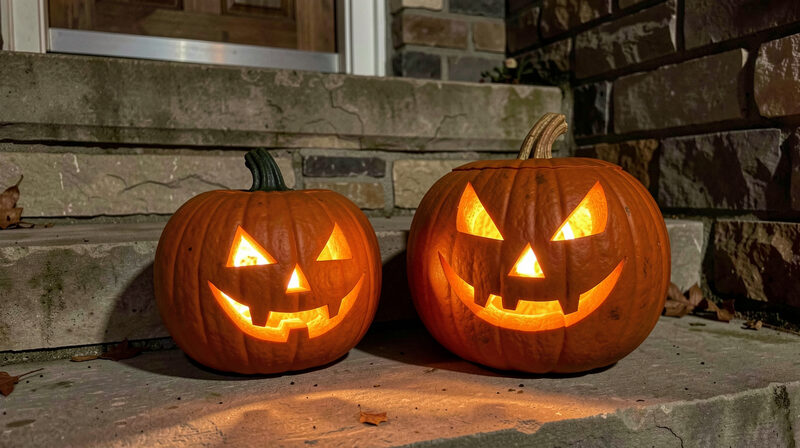
The lantern on the doorstep is usually called a jack o lantern, and it is one of the few Halloween objects with a clear line of descent. It began as a carved root vegetable in Ireland and Scotland, carried by emigrants to North America, and settled into the pumpkin because the pumpkin was larger, softer and far easier to hollow. The name has a second life as well: before it belonged to a lantern, jack o lantern was a term for a wandering light seen over bog and marsh.
A name with two meanings
The phrase jack o lantern was used in English for a will o the wisp, the flickering light sometimes seen over marshy ground, long before it meant a carved vegetable. The jack element was a generic nickname for a man, and the lantern part was literal. The same idea appears in the folk name for the light in several languages. When carved turnips began to be carried on the eve, the name transferred to them, and it is the carved object that has kept the name ever since.
The tale of Stingy Jack
The most told explanation is the story of Stingy Jack, a man who tricked the Devil more than once and was refused entry to both heaven and hell when he died. Left with nowhere to go, he was given a single ember and wandered the earth with it, carrying it inside a hollowed turnip to stop it going out. The tale exists in several versions and is folklore rather than record. It explains the name and the mood, and it is presented here as the story it is, not as a documented event.
The turnip and the beet
In Ireland and Scotland the lantern was carved from a turnip, a large swede or a beet, all of which were common and cheap. These roots are hard, so carving them took real effort and the results were often crude. A turnip lantern is small, heavy and dense, and it holds a candle well because the flesh does not burn easily. Guisers carried them on the eve, and the lantern doubled as a light for the road and as a small, strange object at the door. The practice is recorded in Scotland by the eighteenth century, and the older customs around it are described in the trick or treat history page.
Why the pumpkin replaced it
When Irish and Scottish families settled in North America, they found a native fruit that solved the problem of the turnip. The pumpkin is large, has a soft, easily hollowed interior and a thin, firm shell, and it grows in great numbers. It could be carved quickly, lit easily and made into a lantern far larger than anything a turnip allowed. The switch was practical rather than symbolic, and it happened gradually through the nineteenth century. By the late nineteenth century the carved pumpkin was the standard American lantern, and the turnip was remembered mainly in the countries it came from.
From guard to welcome
The earliest lanterns were protective. A carved face at a door or a carried light on the road was meant to turn away harmful spirits, or at least to stand in their way. Over time the meaning shifted, and by the twentieth century the lit pumpkin had become a signal of welcome: a house with a lantern out was a house taking part. This reversal, from a light that repels to a light that invites, is one of the clearest changes in the history of the holiday, and it is why the modern pumpkin sits beside the open door rather than guarding it.
The lantern in print
The carved pumpkin entered the wider culture through illustration. In the early twentieth century it appeared on countless Halloween postcards and paper decorations, usually glowing warmly and often with a cat beside it. That printed pumpkin fixed the image in the public mind and made it the shorthand for the holiday. The imagery of that period is covered in the vintage Halloween section, and the objects themselves in the collecting page.
What the lantern means now
Today the jack o lantern is the one object that almost every household associates with Halloween, in countries where the holiday is kept at all. It is made of plastic as often as it is made of fruit, and it is lit by a bulb as often as by a candle. The history behind it is unusually well documented, and the fuller account is gathered by the History channel in its page on the jack o lantern's history. What has not changed is the idea at the centre of it: a hollowed thing, lit from inside, left out for the night.
A note on the light inside
The light matters as much as the shell. A candle gives a warm, uneven glow that flickers, which is why the old lanterns looked the way they did, but it also cooks the fruit from the inside and sets a small flame on a wooden step. A modern battery light or LED candle gives a steadier glow, runs cool and can be left on while the household is out. Purists sometimes argue that the flicker is part of the tradition, and a small bulb that imitates a flame answers that objection without the risk. Either way, the object is the same as it has always been: something hollow, something cut, something lit.
Carving one yourself
A reader who wants to make a lantern rather than read about one will find the practical sequence at how to carve a pumpkin that lasts. The short version is to choose a sound fruit, cut a notched lid, thin the wall, carve a bold pattern, dry the cuts and use a light rather than a flame. Done that way, the oldest object in Halloween is also one of the easiest to get right.