Where Halloween Comes From
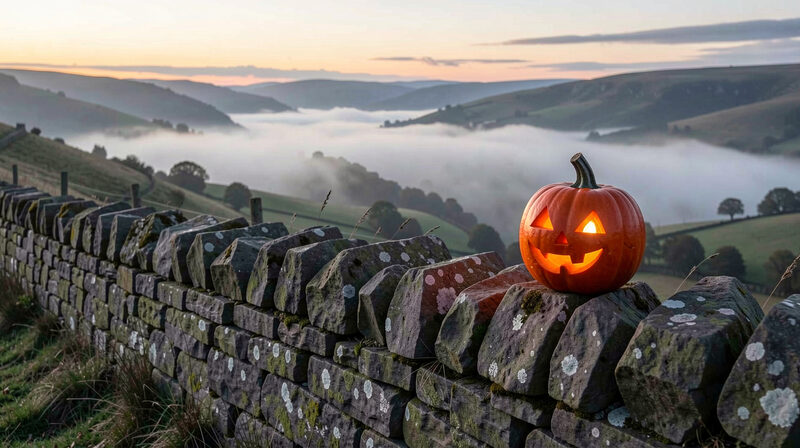
Halloween looks simple from the pavement: a lit pumpkin, a costume, a bowl of sweets by the door. Behind that single evening sits a long and uneven history, part Gaelic festival, part Christian calendar, part nineteenth century print culture and part twentieth century American street custom. This section follows that history in the order it can actually be documented, and it says plainly where the record is thin.
What this section covers
The pages here deal with where the night came from. They start with the road from Samhain to Halloween, which traces a Gaelic harvest festival at the turn of winter, the Christian feast of All Saints fixed on 1 November, and the slow drift of the eve into a night of its own. They continue with the jack o lantern, a lantern that began as a carved turnip in Ireland and Scotland before the North American pumpkin replaced it, and with how trick or treat began, from guising and souling to the porch light and the paper bag.
Three articles, one shared question: which parts of Halloween are inherited, which were invented in the last hundred and fifty years, and which are simply repeated because they sound good.
Why the dates do not line up neatly
The most common version of the story says the Church moved a feast onto 1 November to absorb a pagan festival. The dates do not fit that neatly. A feast of all martyrs was kept in Rome in the seventh century in May, and the dedication of a chapel to all saints at Saint Peter's in the eighth century is what pushed the commemoration towards the first of November. By the ninth century the first of November was widely observed across western Europe. Samhain, the Gaelic marker of winter's start, is attested in medieval Irish literature, and the idea that the boundary between the ordinary world and the otherworld grew thin on that night appears in those texts. Whether one feast replaced the other, ran alongside it, or simply shared a season is still argued by historians, and this section does not pretend the argument is settled.
How the pages are written
Every article in this section names its sources and prefers the documented version over the tidy one. Where a claim rests on a single medieval text, the page says so. Where a practice appears only in the nineteenth century, the page dates it. Where a story is folklore rather than history, such as the tale of Stingy Jack and the Devil, the page presents it as folklore and does not dress it up as a record of fact. That habit matters more than any single article, because Halloween is a subject on which confident nonsense travels faster than careful research.
The fuller background for the night as a whole is set out by the History channel's account of Halloween's origins, which this section uses as a starting point rather than a final word.
Folklore is not a lesser subject
Treating folklore as folklore is not the same as dismissing it. The stories attached to Halloween are the reason the night feels the way it does. The black cat, the mirror, the apple in the bucket, the fire on the hill: each carries a meaning that people acted on long before anyone wrote it down. The pages here describe those beliefs honestly and place them in time, without claiming that a charm once worked or that a spirit once walked. A reader who wants the mood of the old night will find it in the descriptions. A reader who wants the evidence will find that too, kept separate.
Where the section sits in the site
Origins and folklore is the first of four strands. Vintage Halloween takes the story into print, looking at the postcards, paper cutouts and lanterns that carried the imagery from about 1900 to the 1930s. Decorating and carving turns to the practical side, the pumpkin on the step and the light inside it. Celebrating and safety closes the loop with the evening itself, the costumes, the route and the rules that keep it calm.
Read together, the four strands describe a single holiday from four angles: its past, its pictures, its objects and its night.
Reading the night in order
A reader who wants the whole picture can take the section in sequence. Begin with the festival and the feast, then the lantern, then the doorstep. Each page links to the others, so the route can be walked in either direction. A reader who only wants to know why the pumpkin is carved, or when children started asking for sweets, can open that page alone and find the answer near the top.
What this section does not do
The one thing this section does not do is sell. No shop, no brand and no organisation is presented as the keeper of Halloween. The night belongs to everyone who keeps it, and the pages here treat it that way. Where a modern practice is commercial, the page says so and moves on, because the interest is in the custom, not in the merchandise.
What to do next
Start with From Samhain to Halloween for the long view, or jump straight to How Trick or Treat Began if the doorstep is what interests you. Both pages end with the sources they lean on, so the reading can continue past this site.
Origins and Folklore
From Samhain to Halloween
The long road from the Gaelic festival of Samhain to the modern night of October 31, separating the documented history from later invention.
A Gaelic quarter day and a Christian vigil, layered into one night.
Origins and Folklore
How Trick or Treat Began
Guising, souling and the American porch light: how asking for sweets on October 31 became a routine across the English speaking world.
From souling and guising to the porch light and the paper bag.