How Trick or Treat Began
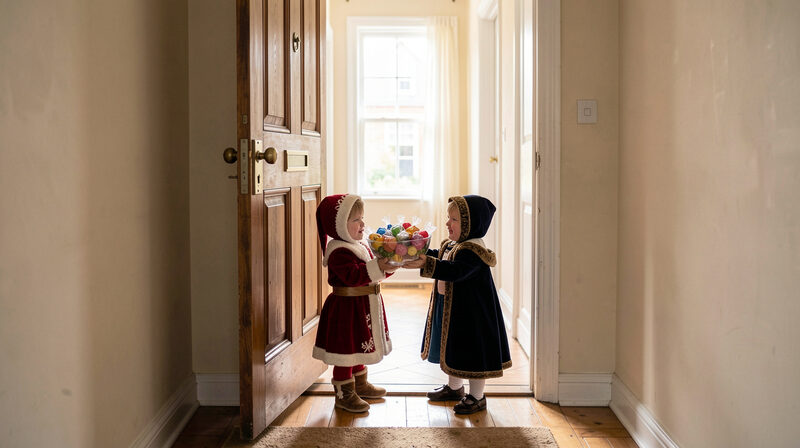
Asking for sweets at the door looks like the oldest part of Halloween and is in fact one of the newest. The phrase itself is less than a century old in print, and the routine of a child in costume knocking on a neighbour's door became standard only in the middle of the twentieth century. What came before it, in Ireland, Scotland and England, were several different customs that all involved going from house to house, and they are the ancestors of the modern doorstep.
Souling and the soul cake
In England and parts of Ireland, the poor went from door to door on the second of November, All Souls' Day, asking for food in return for prayers for the dead. The food was often a small spiced cake called a soul cake, and the practice was known as souling. It was a religious exchange as much as a request for charity: the household gave food, and the visitor gave a prayer. The custom faded with the religious changes of the sixteenth century, but the habit of door to door asking around the turn of November did not disappear.
Guising in Scotland and Ireland
In Scotland the practice was guising, in which children or young people went out in disguise, often carrying a lantern made from a carved turnip, and performed a song, a poem or a joke in exchange for food, coins or nuts. The disguise was the point: the guiser was not simply begging, but playing a part. Records of guising at Halloween go back at least to the eighteenth century, and the poet Robert Burns described the wider night of games and divination in a poem published in 1785. Guising travelled with Scottish and Irish families to North America, where it slowly merged with the other customs of the season.
Mumming and Mischief Night
A third strand was mumming, a form of masked house visiting with a longer history in Britain and Ireland, tied to several festivals rather than to Halloween alone. Alongside it ran a rougher tradition of pranks, which in some places took over the eve itself. By the early twentieth century the pranks had become a real problem in American towns, with gates lifted from hinges, carts moved and worse. The response of schools, newspapers and community groups was to redirect the night towards something organised and harmless, and the most successful redirection was the costume visit to neighbours.
The phrase arrives
The words trick or treat appear in print in North America in the 1920s and spread during the 1930s. The formula carries the old threat and the new bargain at once: a treat, or a trick. The trick was understood as a joke rather than as real damage, and the treat was a small sweet, a coin or a piece of fruit. During the Second World War sugar rationing interrupted the custom, and the sweets themselves were scarce. The practice returned strongly after the war and, with the growth of suburbs and the car, became the routine version of Halloween that most families would now recognise.
Why the porch light
As the custom spread, households needed a way to signal that they were taking part. The lit porch became that signal. A house with its light on and a pumpkin at the door was inviting visitors; a dark house was not. This is a practical solution to a practical problem, and it is why the pumpkin and the doorstep are so closely joined in the modern picture. The lantern had been a way of scaring off unwelcome visitors in its earliest form. By the mid twentieth century it had become a way of welcoming them.
What the sweets were
Early treats were often homemade: popcorn balls, apples, nuts, small cakes and coins. Shop bought sweets took over in the second half of the twentieth century as they became cheaper and more convenient, and as worries about unwrapped homemade food grew. That shift is one reason modern safety advice centres on checking the bag, a topic treated at the trick or treat safety page.
The custom in other places
Trick or treating is not universal. In some countries the night is marked with parties, bonfires or church services rather than door to door visits, and in others it has only recently been adopted. Where the custom arrived, it usually came through American film and television as much as through migration. The wider spread of the holiday is set out by the History channel in its account of the history of trick or treating, which follows the practice from souling and guising to the modern street.
The older customs behind the modern one
It is worth keeping the older forms in view. The guiser with a turnip lantern, the soul cake given for a prayer and the disguised visitor at the door are all part of the same family of practices, and they explain why Halloween is a night for going to see other people rather than staying at home. The carved lantern that guisers carried is treated on its own page at the jack o lantern, and the costumes that replaced simple disguises are covered in Halloween costumes through the decades.
Why it lasted
Trick or treating lasted because it is cheap, local and repeatable. It needs no special building and no expensive equipment, and it turns a street into a small, temporary community for one evening. That is a rare thing, and it is probably the real reason the custom survived while so many other seasonal practices did not. The doorstep, not the shop, is where Halloween has always lived.