Halloween Costumes Through the Decades
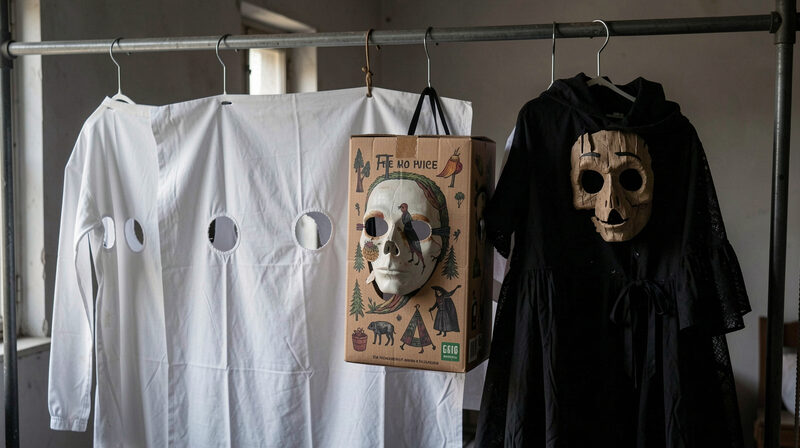
Halloween costume is a record of its decade. Look at what people wore on the thirty first in any year of the last century and you can read the technology of the time, the films that were popular and the money families had to spend. The move from a homemade sheet with two holes in it to a boxed outfit with a printed picture on the front is a story about manufacturing as much as about taste, and it runs decade by decade.
The homemade beginning
In the early twentieth century almost every costume was made at home. A child became a ghost with a sheet, a witch with a black dress and a paper hat, or a cat with a headband and a painted face. Party guides of the period, several of them published by the firms that sold the materials, explained how to build costumes from crepe paper and card. The results were cheap, personal and often charming, and the same guides are one reason the paper decorations of the era survive. The party culture behind them is described in the collecting page.
The 1920s and 1930s
Mass produced costumes arrived in these decades. Firms that already sold party goods began to print and cut costumes from paper and cloth, and the first children's outfits designed to be bought rather than made appeared in catalogues. The style was simple and often generic: a clown, a pirate, a nurse, a gypsy. By the late 1930s several American manufacturers were making costumes on a commercial scale, and rubber masks were being produced alongside them. This is the point at which Halloween dress began to split into the bought and the homemade, a split that still exists.
The 1940s and the war years
The Second World War restricted materials and factory output, and costumes became plainer as a result. Paper and cloth were rationed, and many families returned to homemade outfits for the duration. The imagery shifted towards nurses, soldiers and other figures of the moment, which is a reminder that Halloween dress always reflects the wider culture. After the war, manufacturing capacity returned and the costume trade expanded quickly.
The 1950s and the boxed costume
The 1950s produced the format that most people now associate with the mid century Halloween: a boxed costume with a printed smock and a moulded plastic mask held on by a thin elastic band. Two American firms, Ben Cooper and H. Halpern, dominated the market, and their boxes carried pictures of television and film characters of the year. Westerns, space heroes, cowboys and monsters were the staples. The mask was uncomfortable, hard to see through and usually discarded within an hour, but the format was cheap, fast and hugely popular.
The 1960s and 1970s
Television drove the next two decades. Costumes followed the shows and films children actually watched, from cartoons to science fiction, and the boxed format adapted to whatever was current. The arrival of a major space fantasy film in the late 1970s produced a wave of costumes that is often remembered as the moment Halloween dress became fully tied to the release calendar. Homemade costumes did not disappear; they simply competed with a much larger and faster moving commercial range.
The 1980s and 1990s
The 1980s brought horror film imagery into the mainstream of Halloween dress, and the costume market grew to include teenagers and adults as well as children. The 1990s added the tie in on a larger scale, with superheroes, cartoon teams and film franchises dominating, and with group costumes becoming common among friends. This is also the period when the costume stopped being a single night's purchase and started to become a seasonal retail category of its own.
The 2000s to today
The last two decades have been shaped by two things at once. On one side, film and streaming franchises produce costumes within weeks of a release, and the range available online is larger than any shop could hold. On the other, there has been a strong revival of the homemade and the second hand, driven by cost, by concerns about waste and by the wish to look like no one else on the street. Pet costumes have become a category in their own right. A modern Halloween wardrobe is as likely to be assembled from a charity shop as bought in a box.
What makes a costume last
A few costumes outlive their decade. The sheet ghost survives because it costs nothing and everyone recognises it. The witch survives because the shape is simple and the accessories are easy to make. The vampire and the skeleton survive for the same reason. What these have in common is that they can be assembled from things a household already owns, which is also why they reappear whenever money is short. The commercial costume of any year, by contrast, tends to date the moment the film or show it came from fades.
That pattern suggests a practical rule for anyone choosing a costume now. A costume built around a shape, a colour and a face will still work in ten years. A costume built around a logo will not. Both are fine for one evening, but only one of them is worth keeping in a box.
What the decades still lend us
Each era left something useful. The early period left the sheet ghost and the painted face. The mid century left the boxed mask and the smock. The later decades left the tie in and the group theme. A fuller account of how Halloween dress developed is gathered by the History channel in its page on the history of Halloween costumes. Whichever decade a costume comes from, the practical rules do not change, and they are set out in the trick or treat safety page: it should fit, it should be visible and it should be safe to walk in.